
Presentation slides
📊 DocEng 2026 Conference Presentation Deck
Official 10-slide presentation delivered at ACM DocEng 2026 (28.08.2026).
Slide Deck & Presentation Breakdown
Slide 1: Title & Authors
Slide 01 / 10
Speaker Note: Cost-Aware Human-LLM Collaboration for Post-OCR Corrections in Swiss Historical Newspapers (DocEng 2026, 28.08.2026). Presented by Stergios Konstantinidis, Hayman Lotfy, Prof. Michalis Vlachos.
Slide 2: Motivation & Archival Scale
Slide 02 / 10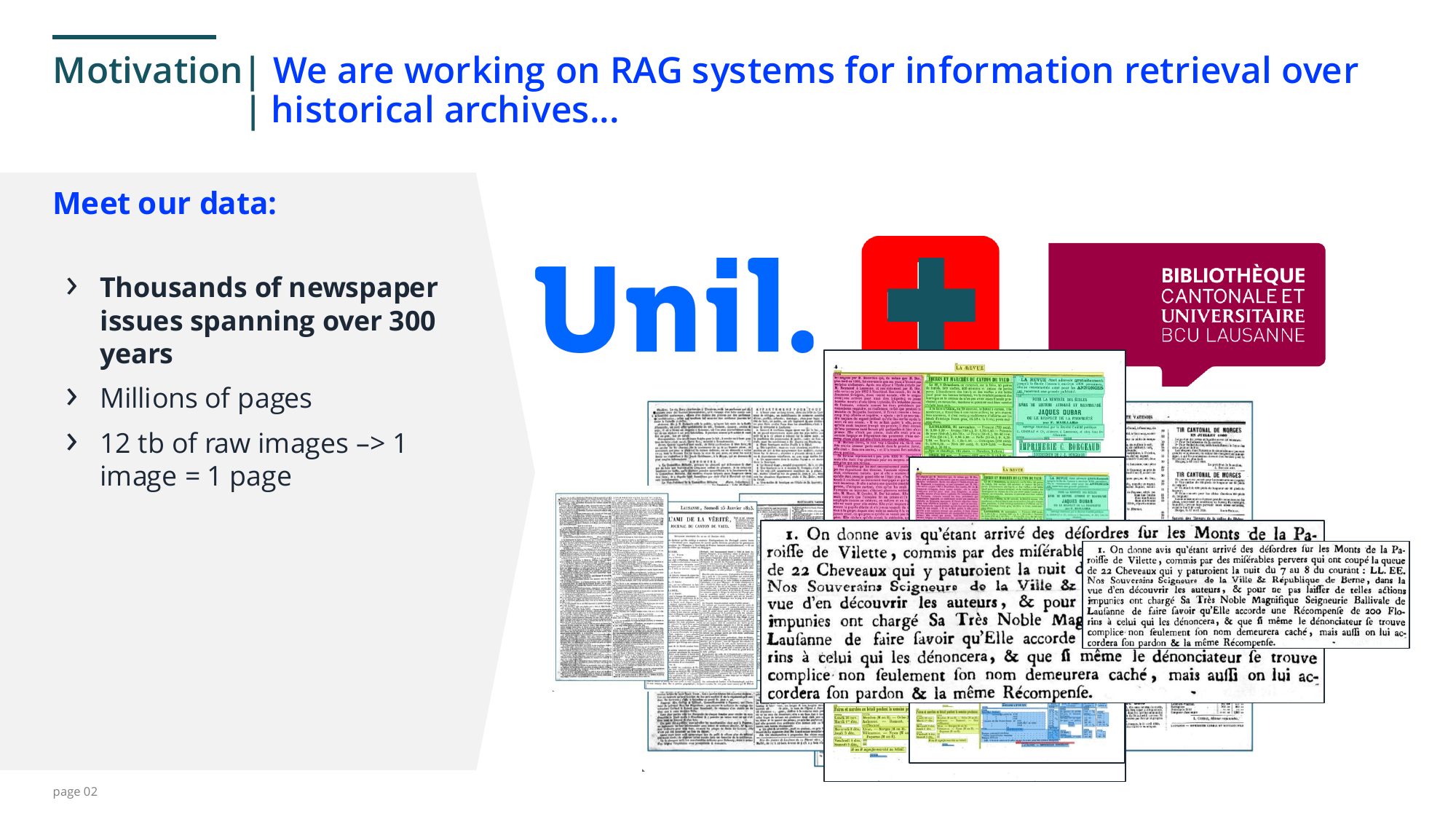
Speaker Note: Building RAG systems for historical archives across 300+ years of newspapers, millions of pages, and 12 TB of raw high-resolution scan imagery.
Slide 3: Why Document Cleaning is Not Straightforward
Slide 03 / 10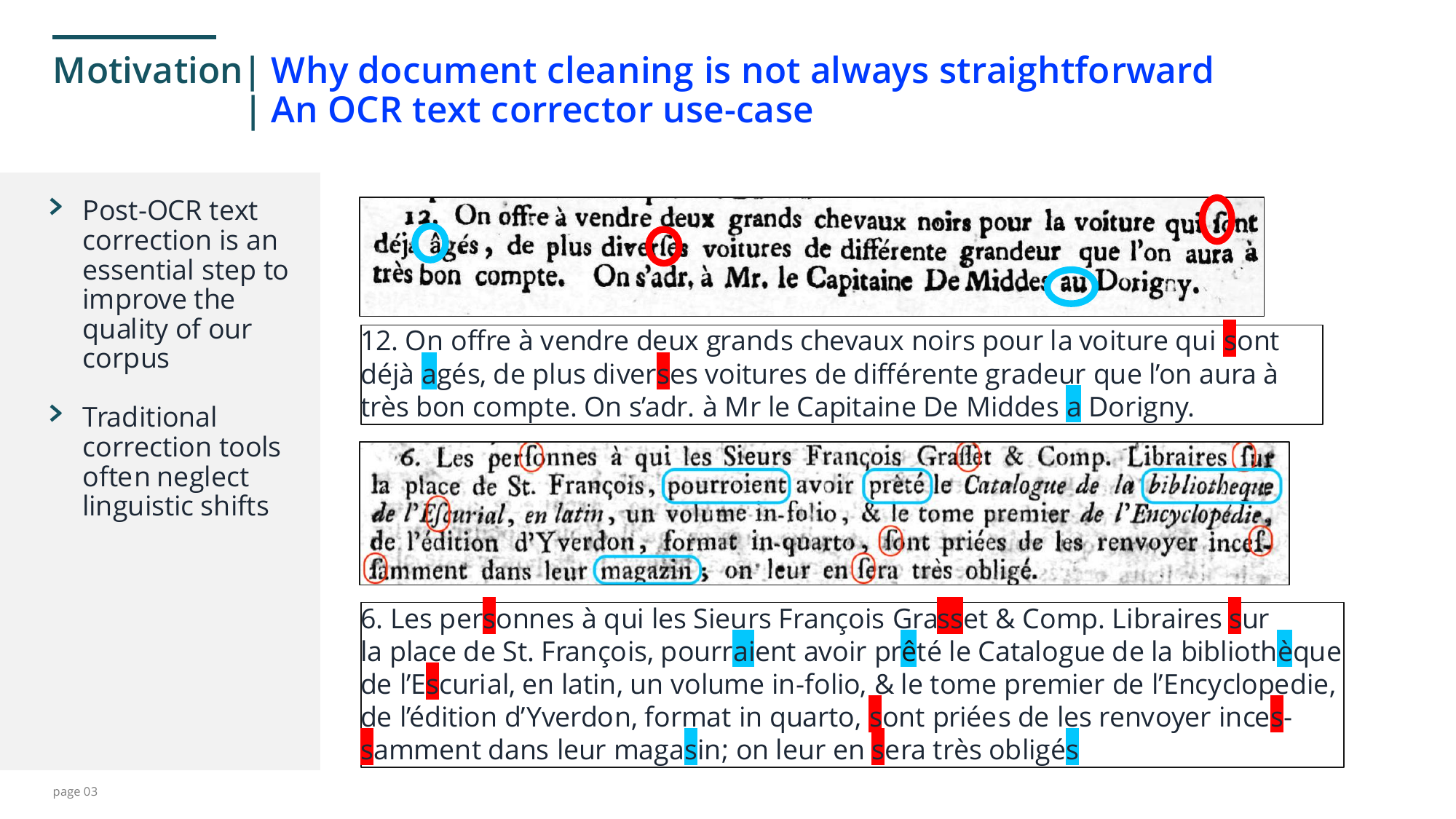
Speaker Note: Post-OCR correction is essential for downstream retrieval, but traditional tools neglect historical linguistic shifts and archaic orthography.
Slide 4: Heterogeneous Segment Utility
Slide 04 / 10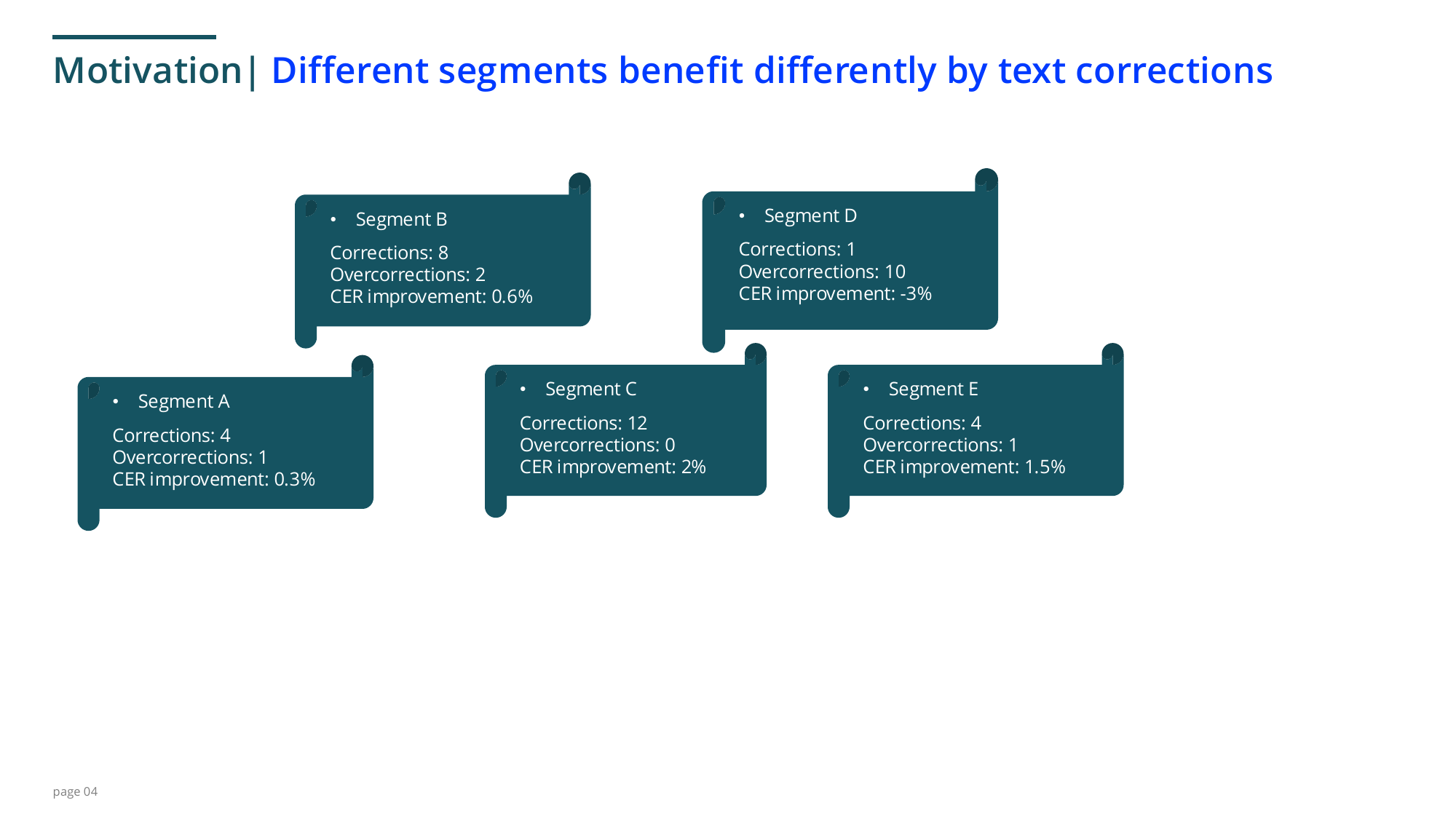
Speaker Note: Different segments benefit very differently: Segment D gains +2.0% CER improvement with zero overcorrections, while Segment B suffers -3.0% CER degradation due to 10 overcorrections!
Slide 5: Optimal Correction Prioritization
Slide 05 / 10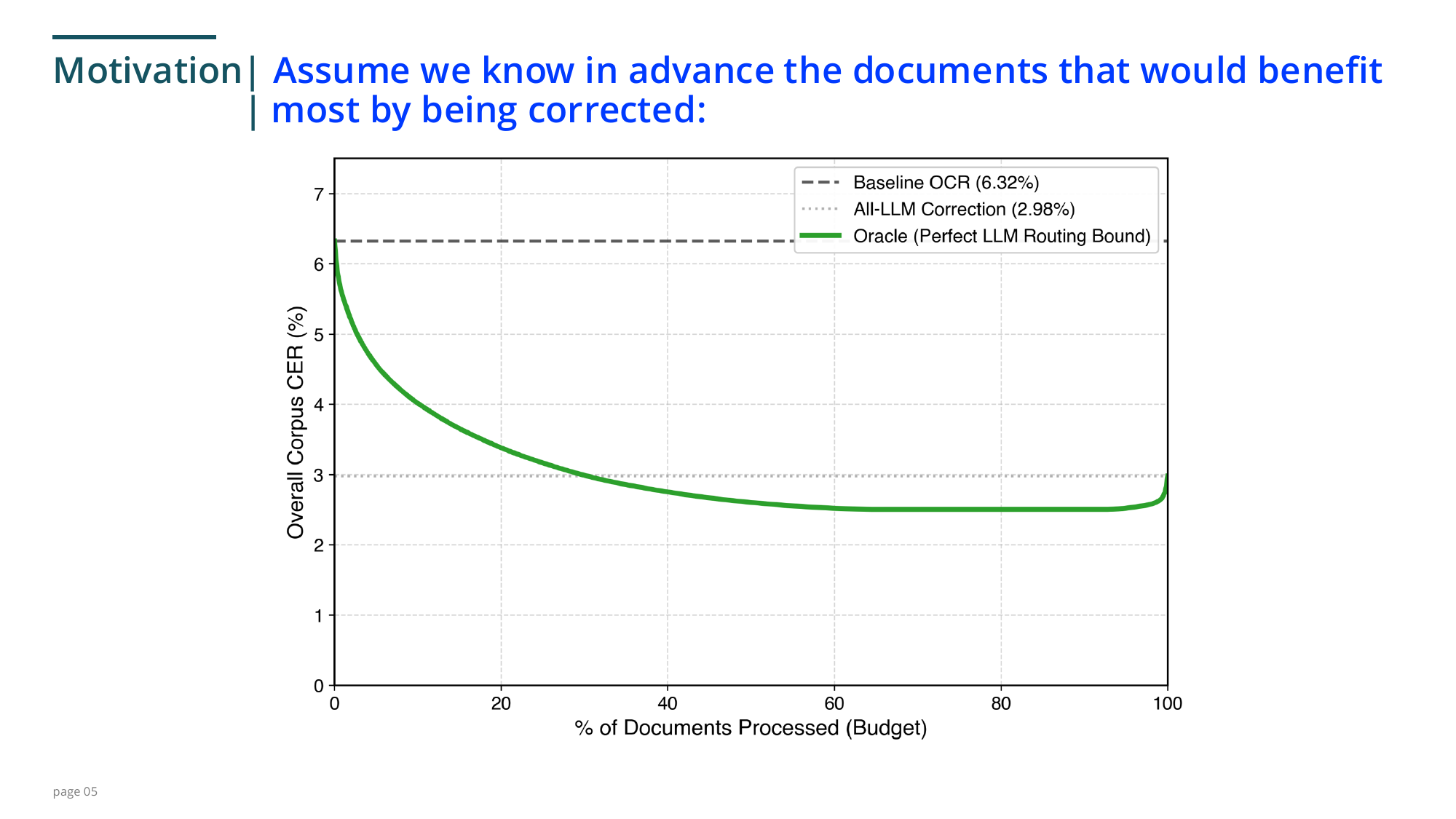
Speaker Note: Theoretical premise: What if we knew in advance which archival documents would benefit most from LLM correction?
Slide 6: The Real-World Dilemma
Slide 06 / 10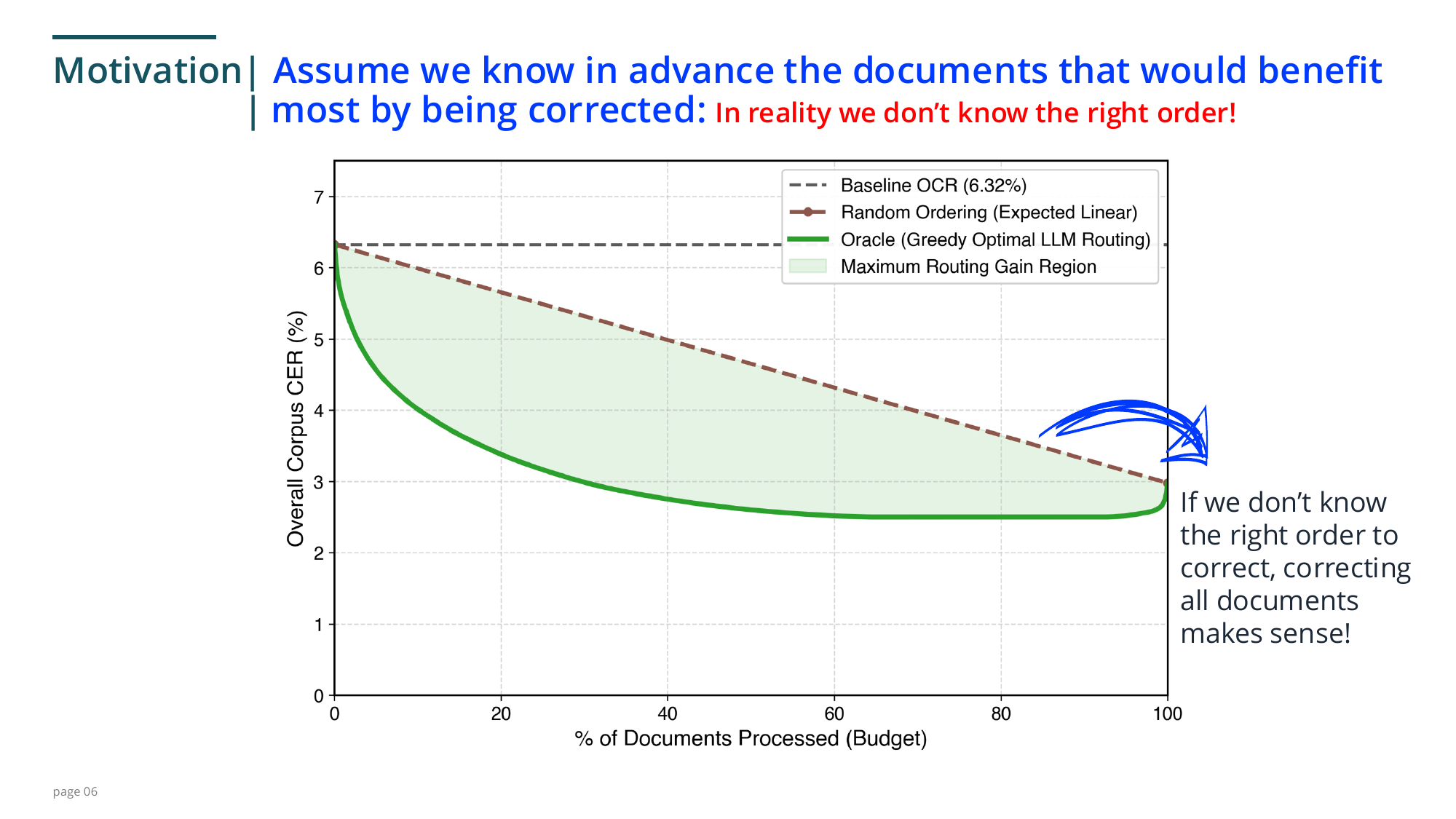
Speaker Note: In reality, ground truth is unavailable. Naively correcting all documents produces unpredictable degradation and wastes massive token budgets.
Slide 7: Our Contribution - Intelligent Routing Architecture
Slide 07 / 10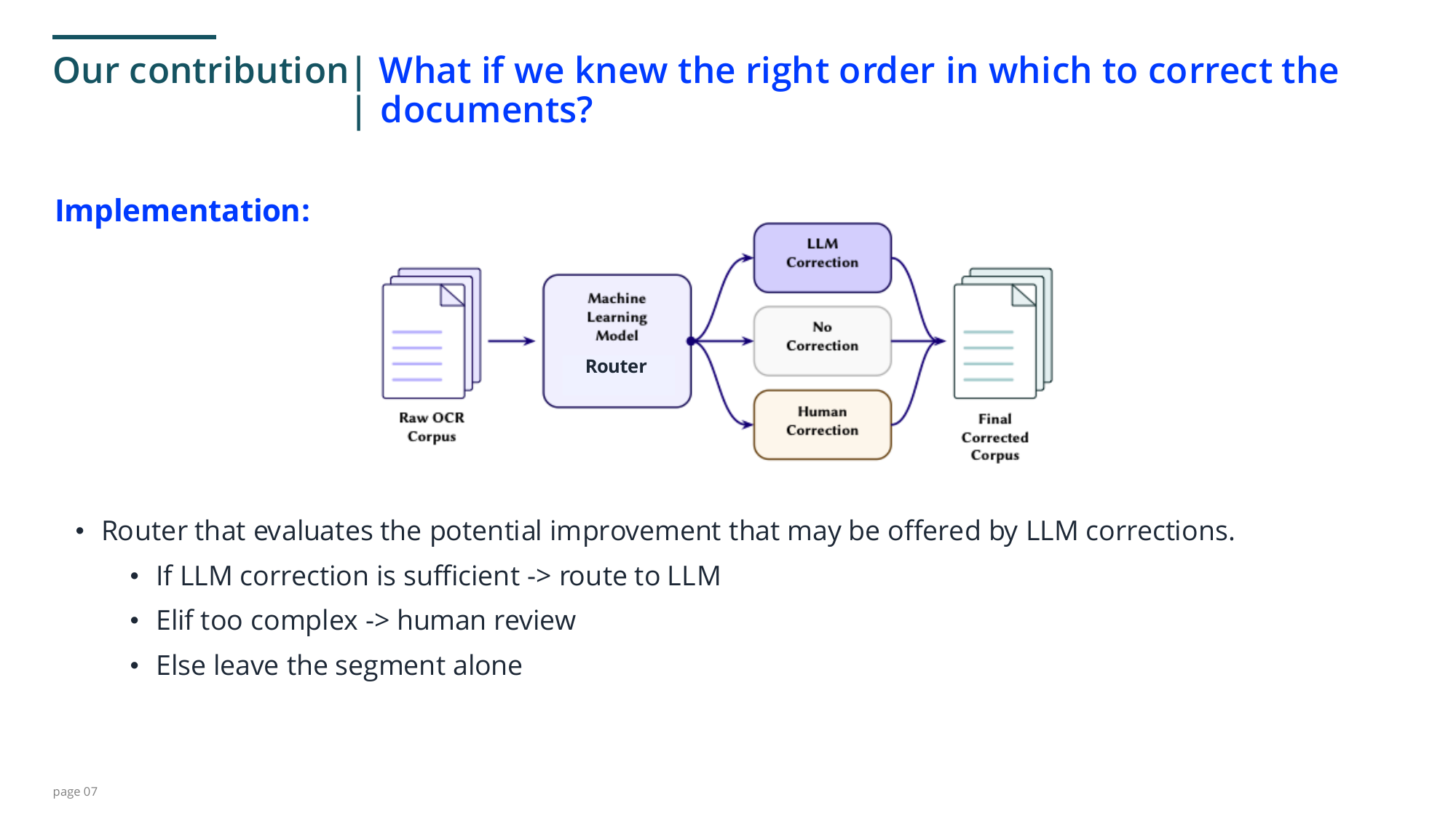
Speaker Note: A machine-learned Router evaluating expected CER benefit: If LLM is sufficient -> route to LLM; if degradation is too severe -> route to human review (<5%); otherwise leave the segment untouched.
Slide 8: Experimental Evaluation & Benchmark Curves
Slide 08 / 10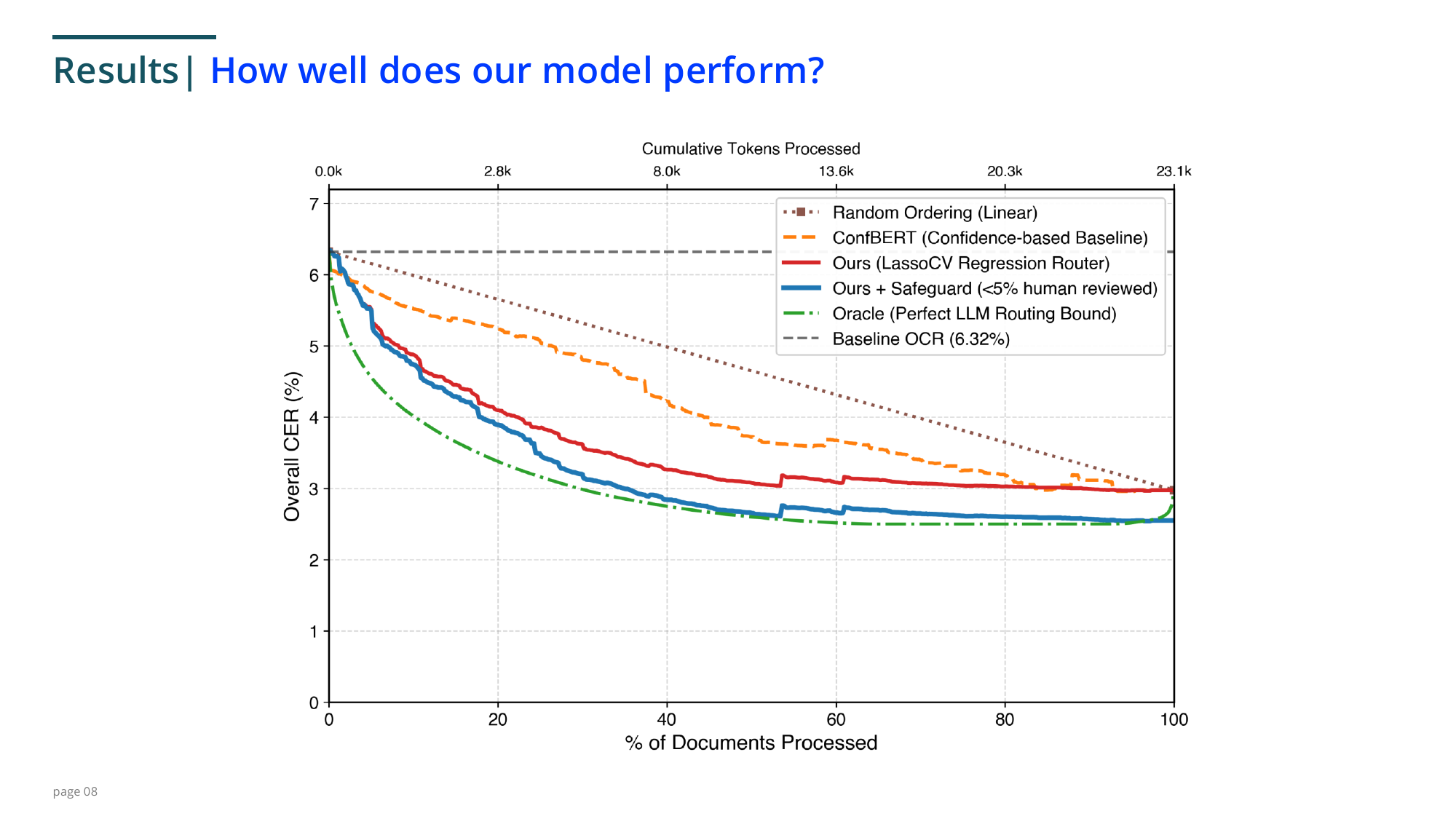
Speaker Note: Empirical results comparing baseline OCR, All-LLM, ConfBERT, and our Cost-Aware Routing framework across historical Swiss periodicals.
Slide 9: Key Takeaways & Research Streams
Slide 09 / 10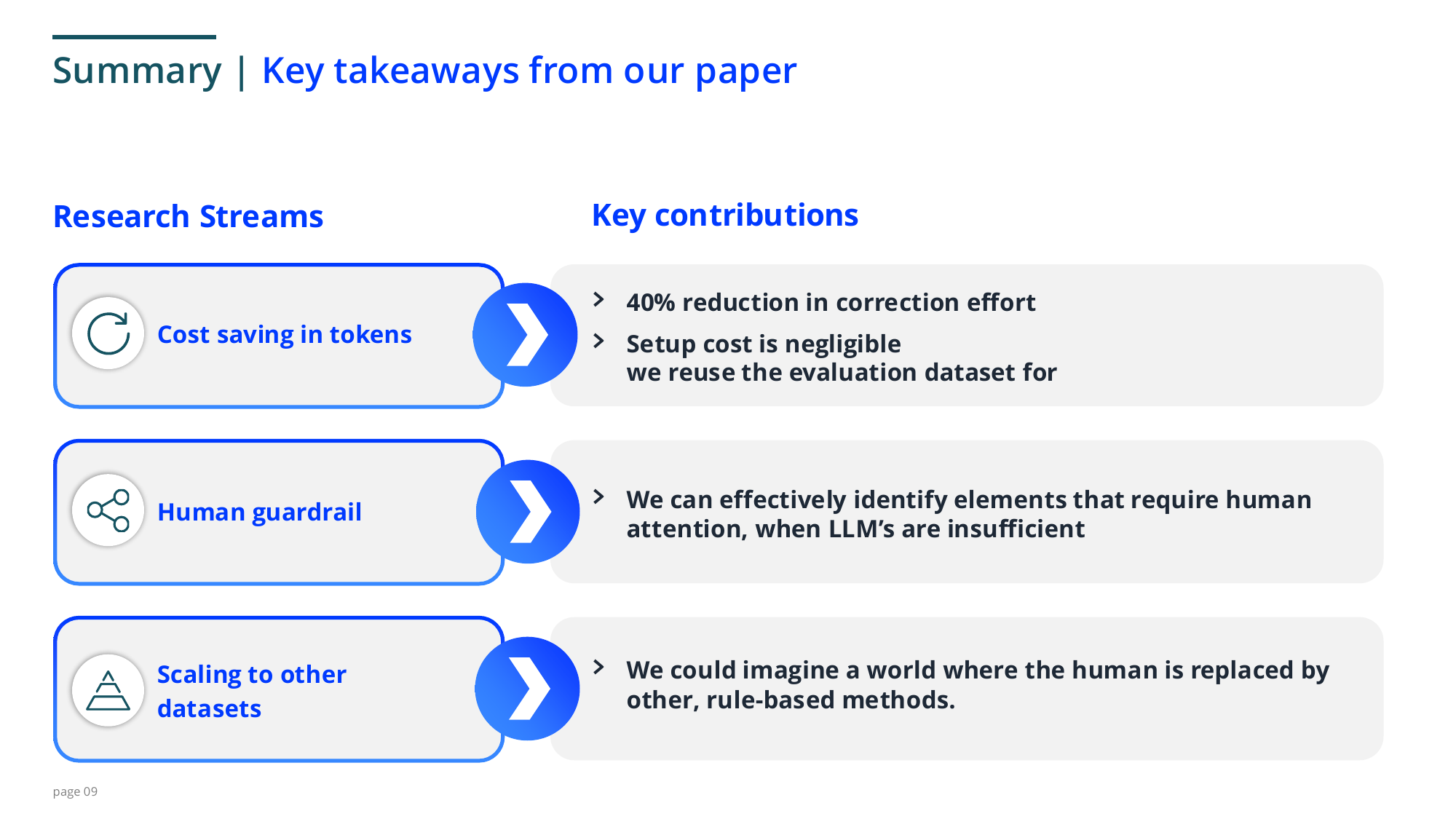
Speaker Note: Key contributions: 40% reduction in correction effort, negligible setup cost, and an effective human guardrail identifying segments requiring expert archivist attention.
Slide 10: Conclusion & Contact
Slide 10 / 10
Speaker Note: Wrap-up, open questions, and research collaboration contact information at UNIL-DESI.
No comments to display
No comments to display