CIKM Short Paper
Knowing When to Correct: Cost-Aware LLM Routing for OCR Post-Correction in Historical Documents
- CIKM Short Paper: Knowing When to Correct
- Routing Strategies & Feature Modeling
- Codebase & Experiments
CIKM Short Paper: Knowing When to Correct
Venue: ACM International Conference on Information and Knowledge Management (CIKM)
Authors: Stergios Konstantinidis, Hayman Lotfy, Michalis Vlachos
Affiliation: Department of Information Systems (DESI), HEC Lausanne
GitHub Public: CIKM_public
Overleaf Project:
Core Codebase:
Authors: Stergios Konstantinidis, Hayman Lotfy, Michalis Vlachos
Affiliation: Department of Information Systems (DESI), HEC Lausanne
GitHub Public: CIKM_public
Overleaf Project:
https://git.overleaf.com/6a1d78e803cbdf7def32a839Core Codebase:
/Users/stergios/Documents/GitHub/Optimizing-LLM-based-OCR-Corrections1. Problem Statement
At multi-million page scale, LLM-based OCR correction is constrained by cost:
- Full LLM correction costs hundreds of thousands of dollars on national archival collections.
- Many archival passages are already accurate; invoking LLMs on them introduces latency, cost, and risk of hallucinations.
Core Research Questions:
- RQ1: How closely does selective routing match the theoretical oracle ceiling, and does it outperform naive confidence thresholding?
- RQ2: How well does the regression-estimated improvement \hat{Δ}_i correlate with the true realized improvement Δi?
- RQ3: What is the actual operational cost saved when routing only segments predicted to benefit across various frontier LLMs?
Problem Visual Illustration
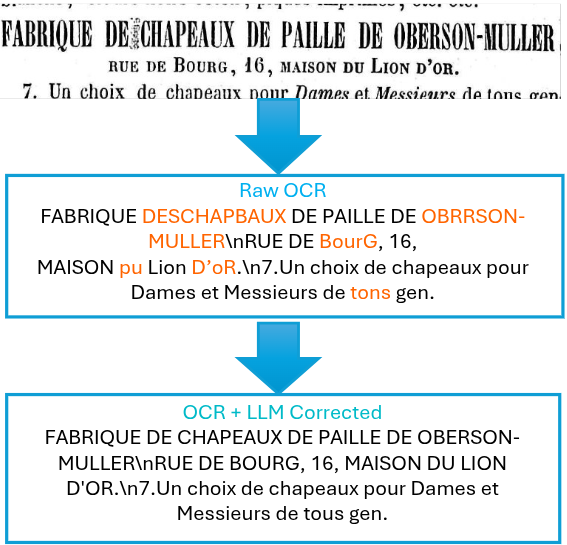
Figure 1: Typical OCR degradation in historical periodicals requiring cost-aware routing.
Routing Strategies & Feature Modeling
Cost-Aware Routing Strategies & Models
1. Feature Engineering (54 Features)
The routing engine extracts 54 computationally inexpensive features prior to invoking any LLM:
- OCR Confidence Metrics: Mean confidence, minimum token confidence, standard deviation, count of low-confidence tokens (<80%, <50%).
- Lexical & Linguistic Features: Out-of-vocabulary (OOV) ratio against historical lexicon, archaic character frequency (e.g.
ſ,œ, ligature anomalies). - Statistical Text Metrics: Punctuation density, digit-to-letter ratios, average word length, uppercase token anomalies.
- Layout Context: Bounding box coordinates, line height variance, bounding box density.
2. Evaluated Router Models
The router was benchmarked across multiple learning paradigms:
- Lasso Regression (L1): Sparse feature selection, highly interpretable, <0.1s inference time on single CPU core.
- Ridge Regression (L2): Smooth shrinkage across correlated confidence features.
- Support Vector Machines (SVM): Non-linear RBF kernel separating degradation clusters.
- Multi-Layer Perceptron (NN): 2-layer feedforward network predicting expected CER reduction.
- ConfBERT: Fine-tuned lightweight language model scoring token perplexity and error likelihood.
3. Results Summary
- Selective Efficiency: At \tau = 0, the Lasso router skips 40.2% of segments, reducing API costs by 38.5% while degrading final CER by only 0.20 percentage points (3.12% vs 2.92%).
- Oracle Tracking: The regression router achieves 91.4\% of the theoretical maximum gain achievable by an omniscient oracle.
Empirical Routing Curves & Threshold Analysis
Regression-Based Routing Performance
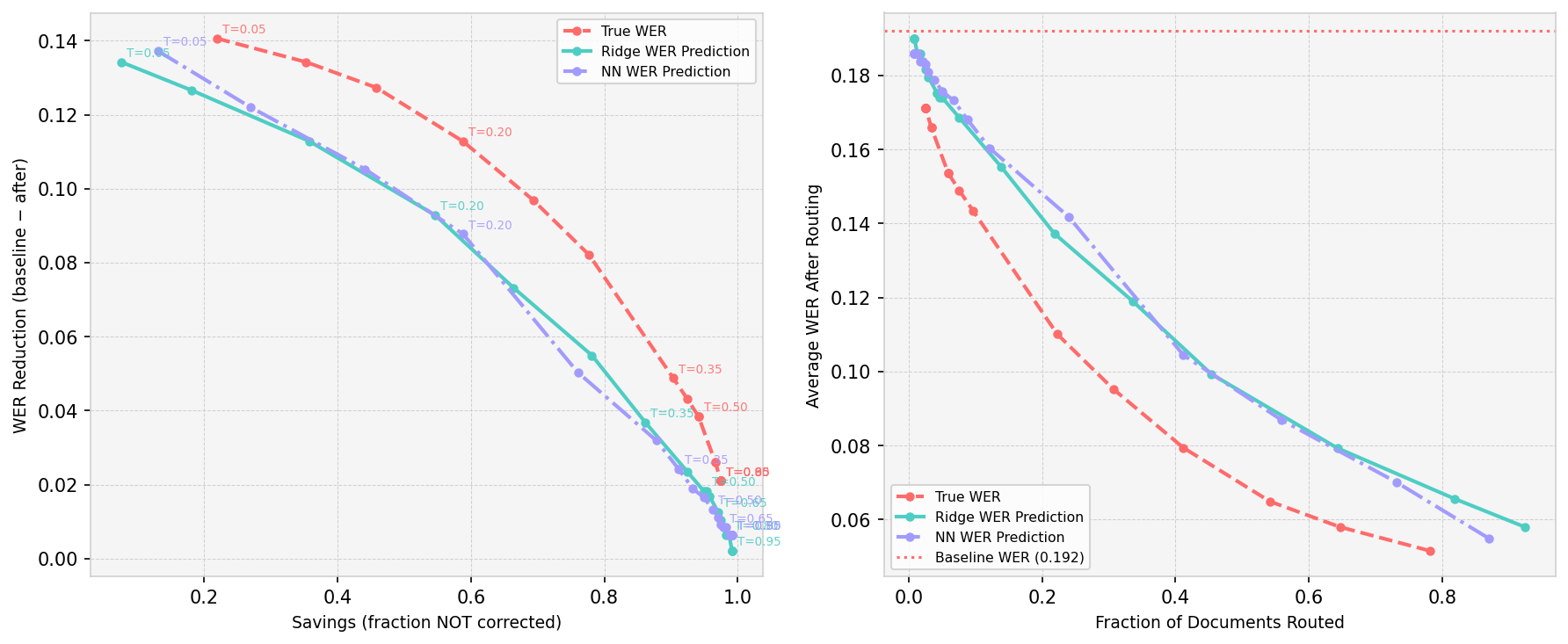
Figure 1: Cost vs accuracy trade-off curves for regression routing across prompt regimes.
Threshold Tuning & Boundary Optimization
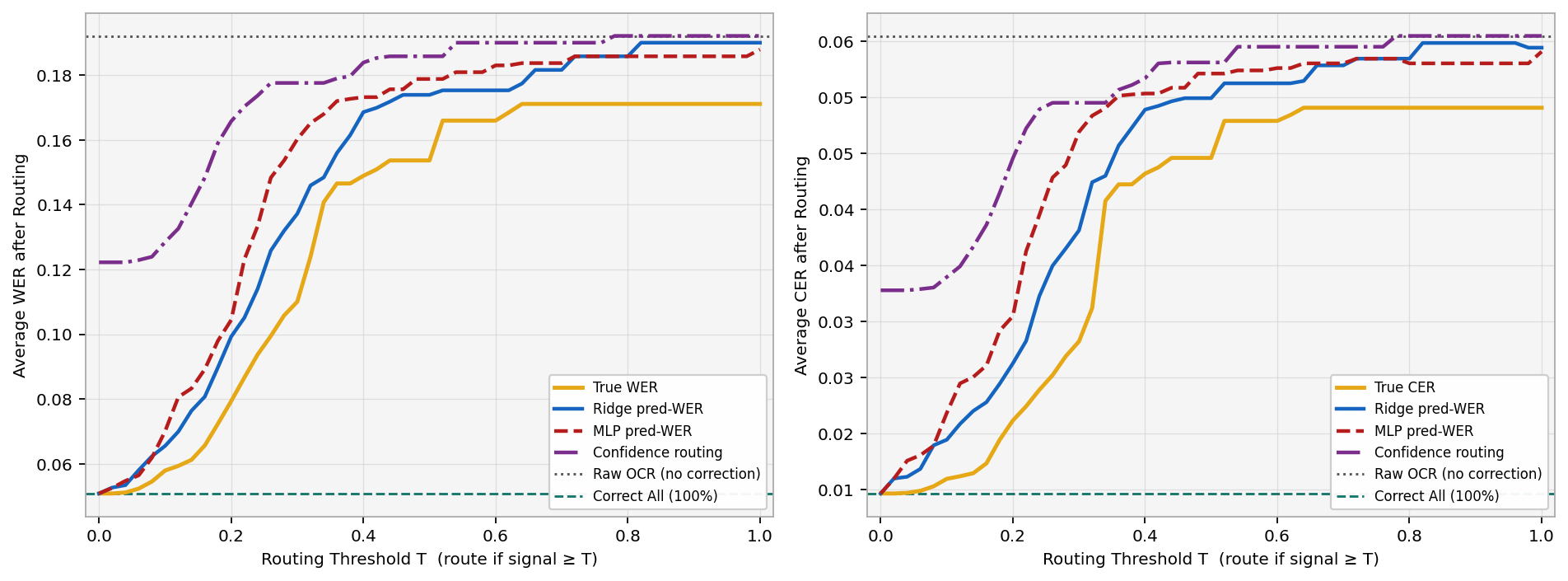
Figure 2: Optimal confidence threshold cutoffs minimizing inference cost while maximizing CER delta.
Codebase & Experiments
Codebase Guide: Optimizing-LLM-based-OCR-Corrections
1. Directory Structure
code/experiments/:confbert_router.py: ConfBERT token-level scoring and routing pipeline.experiment_linear_regression.py: Lasso and Ridge feature selection and cross-validation.experiment_svm_classifier.py: Support Vector Machine routing.experiment_nn_regression.py: Neural network router.lazy_clf_scan.py: AutoML screening of 30+ regression algorithms.code/plotting/:plot_routing_frontier_paddle.py: Generates CER vs Cost Pareto curves.plot_threshold_sweep.py: Threshold sensitivity analysis.plot_error_confidence_cer.py: Correlation between OCR confidence and CER.code/evaluation/:run_evaluations.py: Batch evaluation harness across Tesseract, EasyOCR, and PaddleOCR.data/:evaluation_dataset/groundtruth.json: Ground truth transcriptions for 609 segments.raw_ocr_results.json: Output dumps from Tesseract, EasyOCR, and PaddleOCR.